

by Dom Smith
As England turn the page and turn their attention from Iran to the United States, there is an uncomfortable statistic that will soon be put to the test.
England took the lead in their opener against Iran on Monday thanks to Jude Bellingham’s cool header from a Luke Shaw cross. From there they added goals two, three and four before conceding. They were too far ahead for Iran to stage what would have been a miraculous comeback. England ran out 6–2 winners.
However, all too often in World Cups, the lead has proven a temporary thing rather than a foundation from which to build for England. I have crunched the numbers and compared England’s ability to hold onto World Cup leads to that of world football’s other major nations.
The teams I assessed were those who have won World Cups, plus Portugal and the Netherlands. This meant I considered the World Cup form of ten nations — three from South America, seven from Europe — and omitted nations whose form has fluctuated heavily from one era to another. That meant no Belgium, Croatia, Hungary, Denmark or Sweden.
Embed from Getty ImagesI measured how many times a lead in a World Cup match eventually led to victory, considering World Cup data since but not including the 1966 finals. The data set therefore begins with the 1970 World Cup in Mexico. I counted extra-time victories as victories, but penalty shootout wins counted as a lost lead because the official match result was a draw. The data is correct as of the end of play on Wednesday 23 November at the 2022 World Cup. That meant the last match considered in the data was Spain’s 7–0 thrashing of Costa Rica.
Brazil, Argentina, France and Germany led the way in terms of the reliability with which they won from a winning position. Brazil have won 86 percent of the World Cup matches in which they’ve scored the first goal, with Argentina successful in 84.2 percent of those matches and France in 82.8 percent of theirs. Germany have won 82.7 percent of the matches they’ve led.
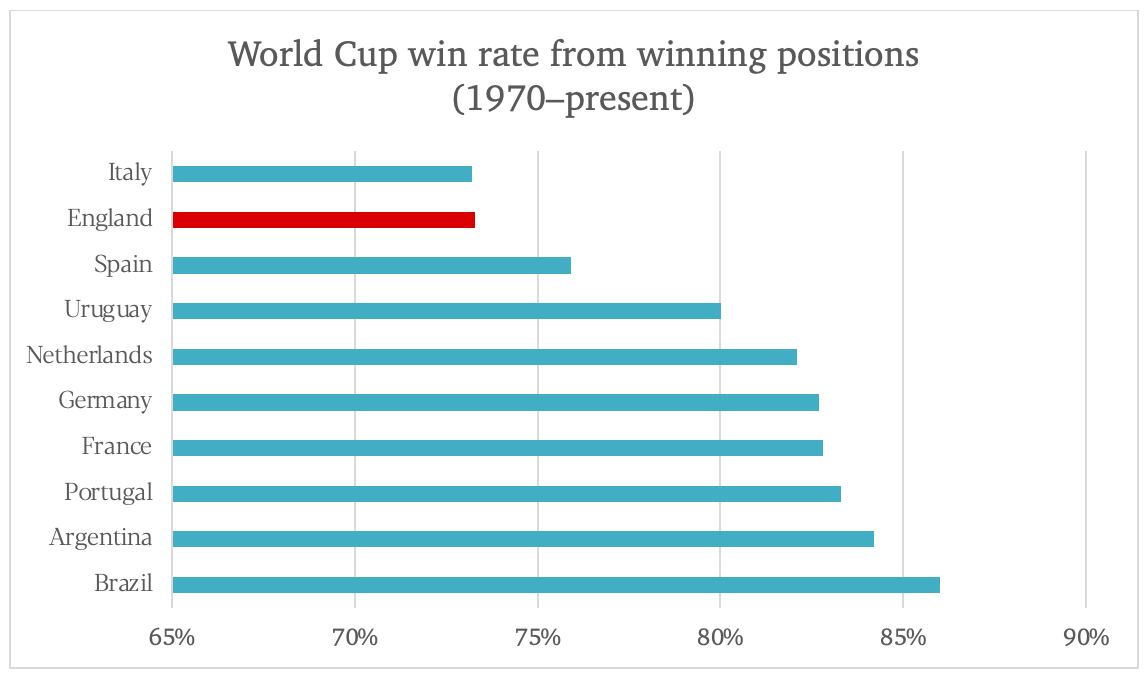
Portugal’s 83.3 percent win rate was a slight surprise but there is an explanation. The Portuguese have missed a number of World Cups over the years and so their data set was much smaller. Brazil have led in 50 matches, for example, while Portugal have only ever been in that position 12 times.
The Netherlands are sitting on an 82.1 percent win rate, with Uruguay on exactly 80 percent. Spain, meanwhile, are on 75.9 percent. Only one nation has won fewer of the World Cup matches they’ve scored first in than England. The Three Lions have won 73.3 percent of those matches — a tenth of a percentage point better than Italy on 73.2 percent. The Italians, though European champions, haven’t even qualified for the current World Cup in Qatar.
Embed from Getty ImagesEngland’s win rate from a winning position therefore means they’ve held onto, regained, or built on their lead in less than three quarters of the time, since 1966. And their data set (30 leads) is smaller than Italy’s (who have led in 41 games), making it even less impressive.
It’s a concerning statistic which includes a number of infamous England World Cup matches. For example, England were 2–0 up in their 1970 World Cup quarter-final as defending champions, but lost to Germany 3–2 after extra time. In more recent years, England have lost leads over Brazil in the 2002 quarter-final, Sweden in the group stage in 2006, and Croatia in their semi-final meeting at Russia 2018.
The data did not consider European Championships or Copa América results. However, if it had done, England’s win rate from a winning position would only fall further behind their major rivals. In 23 Euros matches when they’ve scored first, England have won only 12 of them — barely half. That sees their combined World Cup and Euros percentage plummet to an aggregated 64.2 percent.
So out of every ten tournament games England have led, they haven’t even won seven of them.
Embed from Getty ImagesHow relevant is this? Well, it’s a famed way for England to go out of a tournament: to start superbly well but gradually retreat back into their own half and eventually be picked apart by shrewder opposition. Despite his worst tournament showing being a semi-final finish in Russia, Southgate cannot claim to have put an end to this trope.
England needed stoppage time to beat Tunisia in their opener in Russia despite leading 11 minutes in, and they eventually went out at the semi-final stage to Croatia in spite of Kieran Trippier’s fifth-minute goal to put England ahead.
At Euro 2020, Shaw put England ahead a minute and 58 seconds into the final. They failed to add to their lead and the Italians eventually grappled the match into their control and inflicted upon England an oh-so-painful death.
“For as long as I’ve been watching England, this has been a long-standing issue,” Jack Pitt-Brooke, who covers England for The Athletic, tells EnglandFootball.org. “The best strategy is to keep the ball when you’re ahead, and traditionally English teams have been very bad at keeping the ball. Instead what they’ve done is let to opposition have the ball and retreat to defending their own penalty area. If you do that, you need to be defensively perfect. England have never been defensively perfect. Even now under Gareth Southgate, it’s been an issue. It’s not gone away.
“Gareth Southgate has changed a lot about the England team and their mentality since he took over, but this is one thing which he hasn’t fully solved. The tendency to go ahead, sit back and defend, and then get caught out, is something we’ve seen so much from England over the years.
Embed from Getty Images“It’s been a combination of both tactics and the quality of players,” he reflects. “England have not had the sorts of players that would be well-adapted to succeed in tournaments. They’re about high energy rather than controlling the pace of the game, which is what you have to do in tournament football.”
Pitt-Brooke suspects the profile of players England have historically had does not necessarily suit the sort of possession-based football that best protects against the possibility of losing the lead. But he sees signs of change.
“Under Southgate, they’ve certainly won games they wouldn’t have won in the past. I do think England have probably got a bit better at that over time.”
With the United States, Wales and most likely the knockout stages to come, England’s matches are only going to be more testing from here. The Italy defeat in the Euros final felt like the crescendo of this point. The nadir of England’s most self-destructive trait: holding on for dear life.
England must seek to kill games off rather than sit on narrow leads. Shutting up shop and playing for time is a dangerous game.

 EnglandFootball.org